Bringing century-old footage back to life - denoising, sharpening, defect in-painting and de-flickering - with a physically-grounded degradation pipeline and a state-of-the-art restoration model.
Thousands of hours of archival film survive only as fragile, damaged prints. Restoring them today is a manual, expert-driven craft - so most footage is never seen again.
Frame-by-frame manual restoration takes specialist studios weeks per reel - and costs that only major institutions can bear.
Noise, flicker and damage make raw archival footage hard for audiences to engage with, limiting its cultural reach.
Film stock degrades faster than it can be digitised and restored. Every year, more footage is lost permanently.
No accessible tool exists for smaller archives, historians or private collectors - the scale of the problem demands automation.
81,576 frames of manually curated genuinely archival footage at up to 1440x1080 - watermark-free, heavily degraded, purpose-built to evaluate real-world restoration.
02 - PipelineA physically-inspired degradation pipeline that models film-stock damage, generating temporally consistent, reference-paired training data at scale.
03 - ModelOur restoration model - state-of-the-art on every perceptual metric we measured, outperforming previous SOTA architectures.
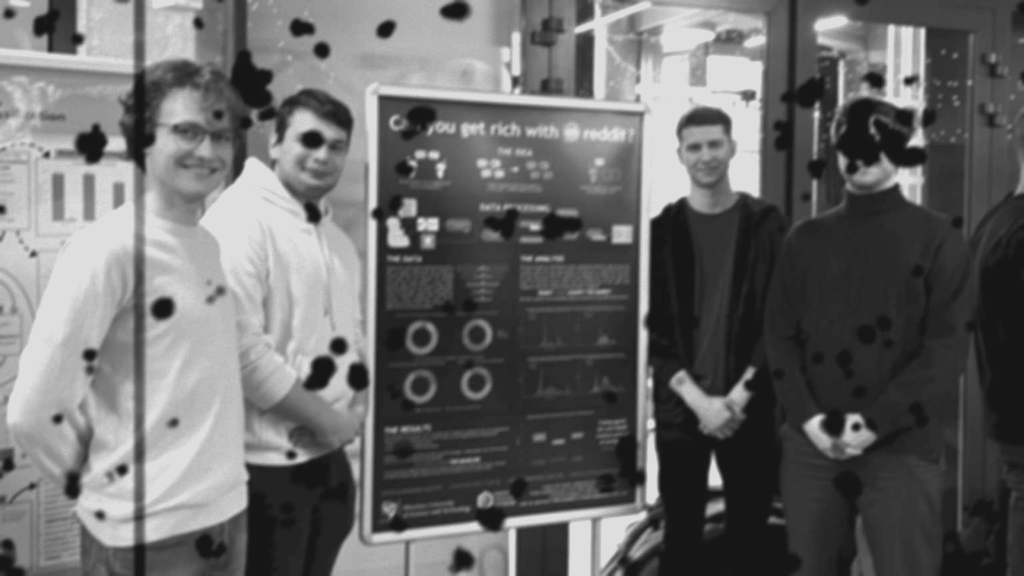
Where the previous standard (SRWOV) mixed film with animation at low resolution and carried watermarks, our set is archival-only, higher-resolution and heavily degraded - a far harder, more honest benchmark. Dataset is sourced from the public domain collections of U.S. Library of Congress.
Sample clips from our benchmark - archival footage from the U.S. Library of Congress
| Property | Previous standard (SRWOV) | Our test set |
|---|---|---|
| Frame count | 29,256 | 81,576 |
| Resolution | 640 x 360 | 1440 x 1080 |
| Content domain | Mixed (film + animation) | Archival film only |
| Watermarks | Present | None |
| Degradation level | Low | High |
A damaged century-old reel has no pristine counterpart to learn from, so supervised restoration is impossible without paired data. The only way to obtain it is to take clean footage and degrade it ourselves - which means a model is only ever as good as how realistically that synthetic damage mirrors real film decay.
You can never capture a clean version of a damaged historical film. Without real pairs, training depends entirely on the realism of synthetic degradations.
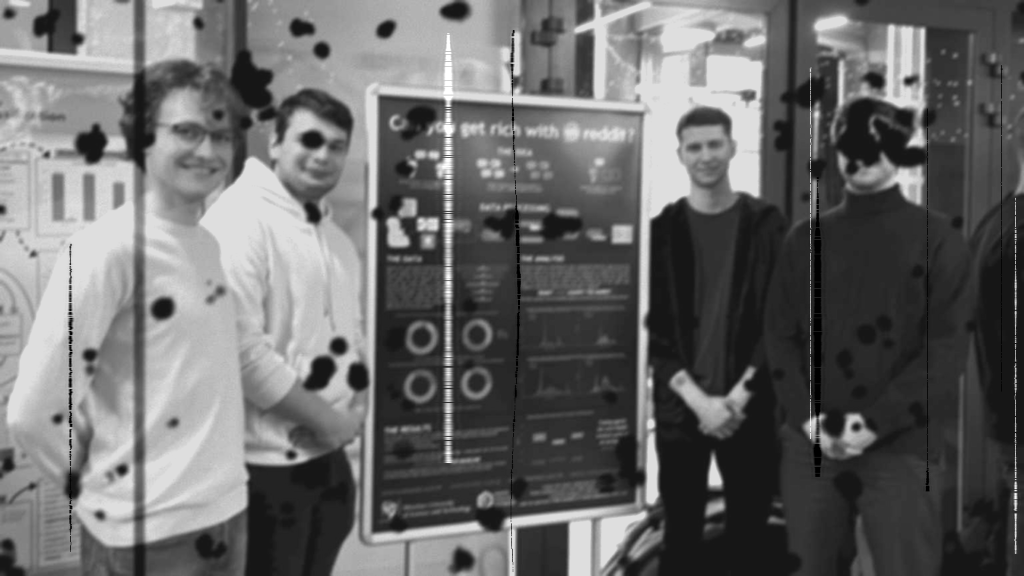
Earlier synthesisers keep frames structurally close to the clean original - high SSIM, low LPIPS - failing to replicate genuine film damage, so models under-restore real footage.
AbsoluteDegradation applies six ordered, physically-grounded stages to produce heavier, more realistic and temporally coherent damage - plus a per-frame degradation mask - closing the domain gap and improving every backbone.
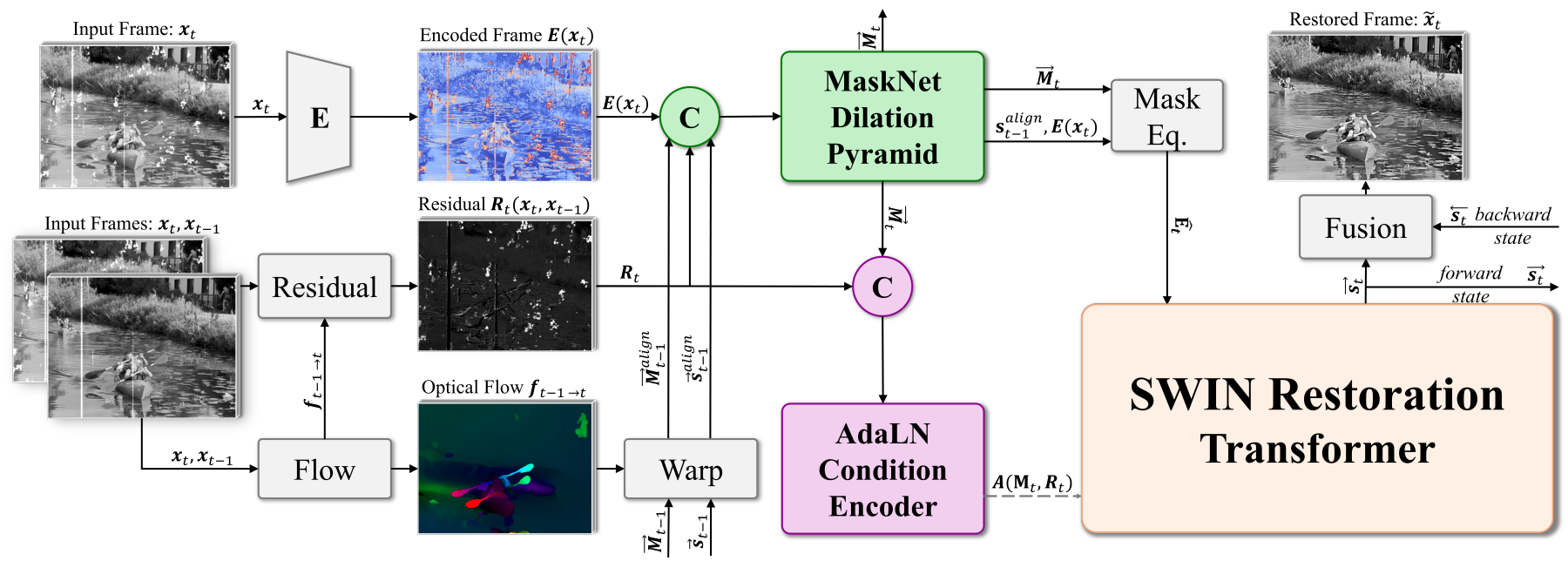
Where prior restoration models treat every frame identically, DART first asks where the damage is and how severe - then restores accordingly. The result is a content-adaptive process that outperforms every prior architecture on our archival benchmark.
Three parallel branches at dilation rates d∈{1,2,3} localise artifacts across scales - from fine grain to coarse scratches - producing a dense per-frame damage mask.
Per-frame damage severity is distilled into a global signal that modulates every Swin Transformer block via Adaptive Layer Norm - shifting restoration from static to content-adaptive.
The loss is weighted by the degradation masks produced by our synthetic degradation pipeline, steering the model to repair only the genuine artifacts while leaving authentic footage untouched.
Source footage: public-domain archival film from the U.S. Library of Congress.
Swapping the training data alone makes the difference: BasicVSR++, RTN and MambaOFR all score substantially better on every no-reference perceptual metric when trained on AbsoluteDegradation instead of the prior BOF pipeline. Built on the same data, DART outperforms every competing method on our archival benchmark.
| Training data | BRISQUE ↓ | CLIPIQA+ ↑ | MUSIQ ↑ | MANIQA ↑ |
|---|---|---|---|---|
| BOF | 30.62 | 0.313 | 32.55 | 0.170 |
| AbsoluteDegradation (ours) | 20.68 | 0.369 | 42.91 | 0.238 |
| Training data | BRISQUE ↓ | CLIPIQA+ ↑ | MUSIQ ↑ | MANIQA ↑ |
|---|---|---|---|---|
| BOF | 26.74 | 0.370 | 36.74 | 0.213 |
| AbsoluteDegradation (ours) | 16.59 | 0.438 | 46.77 | 0.276 |
| Training data | BRISQUE ↓ | CLIPIQA+ ↑ | MUSIQ ↑ | MANIQA ↑ |
|---|---|---|---|---|
| BOF | 32.79 | 0.347 | 38.81 | 0.221 |
| AbsoluteDegradation (ours) | 20.28 | 0.419 | 47.24 | 0.278 |
| Training data | BRISQUE ↓ | CLIPIQA+ ↑ | MUSIQ ↑ | MANIQA ↑ |
|---|---|---|---|---|
| BOF | 19.89 | 0.366 | 41.46 | 0.220 |
| AbsoluteDegradation (ours) | 14.39 | 0.422 | 46.87 | 0.266 |
| Training data | BRISQUE ↓ | CLIPIQA+ ↑ | MUSIQ ↑ | MANIQA ↑ |
|---|---|---|---|---|
| BOF | 35.52 | 0.320 | 39.48 | 0.225 |
| AbsoluteDegradation (ours) | 23.33 | 0.357 | 44.75 | 0.254 |
Swapping in AbsoluteDegradation training data improves every backbone - the gains are pipeline-driven, not model-specific.
| Method | BRISQUE ↓ | CLIPIQA+ ↑ | MUSIQ ↑ | MANIQA ↑ |
|---|---|---|---|---|
| Input frames | 47.86 | 0.248 | 26.84 | 0.162 |
| RVRT | 38.55 | 0.300 | 35.55 | 0.200 |
| BasicVSR++ | 21.94 | 0.369 | 40.27 | 0.237 |
| RTN | 17.77 | 0.401 | 45.51 | 0.262 |
| MambaOFR | 30.11 | 0.349 | 39.80 | 0.233 |
| DART (ours) | 15.87 | 0.433 | 51.23 | 0.301 |
No-reference metrics can reward hallucinated detail, so we asked people instead. In a blinded two-alternative forced-choice study, raters compared restorations of our archival clips from the same architecture trained on the baseline (Bringing Old Films) pipeline versus AbsoluteDegradation - and picked ours in 64.7% of trials.
@inproceedings{jastrzebski2026absolutedegradation,
title = {{AbsoluteDegradation}: A Physics-Inspired Synthetic Film-Degradation Pipeline and Archival Film Restoration Benchmark},
author = {Jastrz{\k{e}}bski, Miko{\l}aj and Glinkowski, Dawid and Zieli{\'n}ski, Dawid and Borkowski, Daniel and Koz{\l}owski, Wojciech and Adamczewski, Kamil},
booktitle = {Advances in Neural Information Processing Systems (NeurIPS), Evaluations and Datasets Track},
year = {2026}
}